



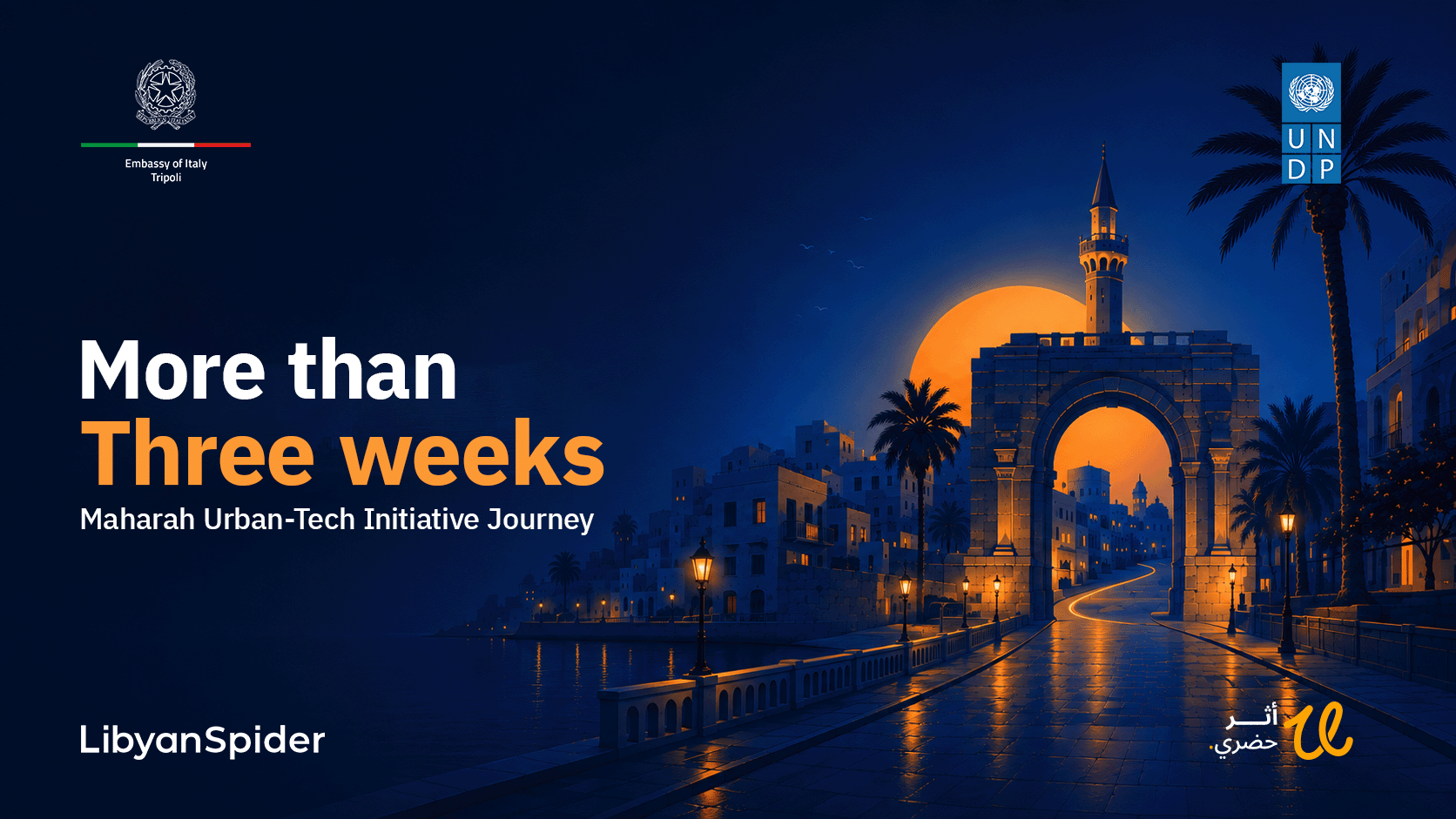
More Than Three Weeks, Maharah Urban-Tech Initiative Journey
There is something remarkably familiar about the number three.
In technology, we instinctively think in threes. Every digital system begins with an input, transforms it through a process, and produces an output. Innovation advances through cycles of building, measuring, and learning, while successful digital transformation depends on balancing people, processes, and technology.
Cities are not so different.
Urban development is rarely shaped by a single intervention. It emerges through the careful balance of social, economic, and environmental priorities; through the relationship between people, places, and activities; and through the collaboration of disciplines and institutions working toward a shared vision.
Perhaps that is what makes Urban-Tech so compelling. It exists at the intersection of these two worlds, where technology and urban development converge to address challenges that neither can solve in isolation.
Only after the Maharah Urban-Tech Bootcamp ended did it become clear that the journey had followed the same rhythm. Three weeks. Three stages of transformation. Countless conversations, unexpected challenges, and moments that quietly reshaped not only the participants, but also the understanding of innovation, collaboration, and the cities the initiative set out to improve.
Before There Was a Bootcamp
Before there was a curriculum, a training room, or multidisciplinary teams working on urban solutions, there was a period of exploration.
We knew the ambition behind the initiative: to bring together technology and urban development to address real challenges facing Tripoli. What we did not yet know was how to translate that ambition into a program that people would understand, connect with, and ultimately believe in.
Urban-Tech was still a relatively unfamiliar concept in the Libyan local context. Introducing the field itself was one step; introducing the mindset behind it proved to be a far more demanding task. The more we explored the idea, the more we realized that Urban-Tech begins long before technology. It begins with changing the way we look at cities.
We often accept urban challenges as part of everyday life. Traffic, deteriorating public spaces, fragmented services, and complicated administrative procedures gradually become normal. Maharah challenged us to look beyond these symptoms and ask what systems were producing them. Traffic, for example, is not simply traffic—it is a question of mobility. Like many urban challenges, what appears to be a single problem is often the result of a much larger urban ecosystem.
That realization became one of the foundations of the program. Before bringing participants together to design digital solutions, we first had to define the mindset we hoped they would develop. Technology, we believed, should never be the starting point. Understanding the city should.
The same realization shaped how we introduced Maharah to others. One question kept returning:
Who is Maharah Urban-Tech for?
At first, we tried to answer by profession—architects, urban planners, software developers, UX designers, entrepreneurs. Eventually, we realized we had been asking the wrong question.
Maharah was never designed for a single discipline. It was designed for the conversations that emerge when disciplines come together.
As we continued designing the program, we were also learning from the city itself. Through stakeholder meetings, focus group discussions, and a citywide survey, we listened to municipalities, institutions, practitioners, academics, and community members. Every conversation revealed a different perspective, yet they all reinforced the same lesson: cities cannot be understood—or improved—from a single discipline.
Throughout those early weeks, we heard the same concerns repeatedly. The field was too complex. The timeline was too ambitious. Three weeks would never be enough.
Those concerns were fair.
Urban-Tech is inherently multidisciplinary, and meaningful innovation rarely fits neatly into a schedule. Maharah was never intended to complete innovation in three weeks.
It was intended to create the conditions for innovation to begin.
Because before solutions can be designed, prototypes can be built, or partnerships can be formed, something more fundamental has to happen first.
People have to start seeing cities differently.
The next question, then, was simple: who would be willing to take that journey?
It Started with Names
Then the applications started arriving.
After weeks spent designing the program, discussing Urban-Tech, and defining what Maharah hoped to become, we finally reached the moment when people entered the story. More than two hundred applications arrived from architects, urban planners, software developers, UX/UI designers, engineers, project managers, and professionals from many other backgrounds.
At first, they were simply names on a registration form. Then interviews changed that.
One conversation at a time, those names became people with different motivations, aspirations, and perspectives. Some demonstrated impressive technical expertise. Others stood out because of their curiosity, their willingness to learn, or the way they approached problems. It quickly became clear that participant selection was not about identifying the most accomplished individuals. It was about understanding who could thrive in an environment unlike anything most of them had experienced before.
As the interviews progressed, another realization emerged.
Every applicant was asked the same question:
“Are you comfortable working in teams?”
Almost everyone answered yes.
But the conversations quickly revealed that collaboration meant different things to different people. Architects had worked with architects. Developers had built projects with other developers. Even within universities, opportunities to collaborate across disciplines were surprisingly rare.
This was not a reflection of the participants' abilities. It reflected the environments many of us had been educated in.
That realization shaped one of the program's earliest design choices. Technical skills mattered, but they were not enough.
We were not looking for the strongest architect or the most experienced developer. We were looking for people who were curious enough to question their own assumptions, open enough to learn from another discipline, and willing to build something together.
Those qualities ultimately proved far more valuable than the strongest portfolio.
Participant selection shaped much more than the cohort itself. It laid the foundation for every conversation, every disagreement, every breakthrough, and every solution that would emerge over the following three weeks.
Learning to Speak the Same Language
One moment from the first day has stayed with me ever since.
As participants settled into their newly assigned teams, a simple question emerged: did anyone already know the teammate sitting beside them? One participant smiled and replied.:
“Not really… she's technical, and I'm an architect.”
It was such a simple answer.
Yet it perfectly captured where everyone was at the beginning of the bootcamp.
For years, many participants had learned, studied, and worked alongside people who shared the same background and spoke the same professional language. Maharah brought together architects, urban planners, developers, designers, and project managers—not simply to contribute their expertise, but to learn how to understand one another.
That was where the real work began.
The program reflected that challenge from the very beginning. During the first week, discussions focused on sustainable urban development, land use, urban regulations, heritage, and Design Thinking. For many participants from technical backgrounds, these were entirely unfamiliar conversations. Developers who were accustomed to thinking in terms of systems and software suddenly found themselves discussing how cities evolve, why public spaces matter, and how urban decisions shape everyday life.
Then the dynamic quietly shifted.
As the program moved into inclusive design, UX/UI, digital product development, and technical solution design, many participants from urban and architectural backgrounds found themselves in unfamiliar territory. The people who had confidently explained urban concepts only days earlier were now asking questions about user journeys, interfaces, technical feasibility, and user experience.
By the final week, the distinction between technical and urban backgrounds had begun to fade. Business strategy, marketing, urban finance, and storytelling challenged nearly everyone equally. Regardless of where they had started, every participant had, at some point, become a beginner.
That was not accidental.
The bootcamp never allowed one discipline to remain the expert for very long. Everyone had the opportunity to teach, and everyone had the opportunity to learn.
Gradually, something began to change. Participants stopped speaking solely from the perspective of their own discipline and started asking better questions, listening more carefully, and building on one another's ideas.
If there was one period that challenged us as the program team, it was the end of the first week. We had spent months designing the initiative, yet the teams were still learning how to work across disciplines, many ideas remained unclear, and meaningful collaboration had not yet fully emerged. By the end of the first week, it was difficult to imagine how these early conversations could become meaningful urban solutions within just three weeks.
The first breakthrough was not a prototype. It was not a presentation. It was the moment a group of architects, developers, designers, and planners stopped thinking as separate specialists and began thinking as one team.
From Trainees to Innovators
If there is one thing that defines Maharah urban-tech beyond its presentations, prototypes, and solutions, it is the transformation that unfolded throughout the journey.
Over the course of three weeks, ideas and people evolved side by side. Looking back, it is difficult to separate one from the other. As solutions became more thoughtful, the teams behind them became more confident. As participants learned to question their assumptions, their ideas became stronger in return. One transformation continually shaped the other.
Ideas rarely emerge fully formed. They begin as rough sketches, scattered notes, or conversations that seem to lead nowhere. Throughout the bootcamp, every lecture, mentoring session, discussion, and field visit added another layer to those ideas. Some were abandoned altogether. Others returned to the drawing board several times before gradually taking shape. What appeared to be a finished solution one day often looked completely different the next.
One of the greatest privileges throughout the initiative was watching that evolution unfold in real time. An idea would begin as a few notes on a worksheet, be challenged during mentoring, return to the drawing board, take on a completely different direction after a lecture, and continue evolving through conversations within the team. More than once, a solution seemed complete, only to be reshaped by a single question or a new perspective.
That process revealed an important characteristic of innovation. Innovation is rarely defined by a single breakthrough. Instead, it grows through countless moments of questioning, refining, and rebuilding. The strongest solutions were not necessarily those that began with the strongest ideas; they were the ones whose teams were willing to keep listening, keep adapting, and keep improving.
By the end of the program, those evolving ideas had taken shape as four distinct responses to real urban challenges. One explored how urban data could support better planning and decision-making; another reimagined access to cultural heritage through digital experiences; a third tackled one of the city's everyday mobility challenges through smarter parking; while another sought to simplify the way citizens navigate public services. Although each solution addressed a different problem, they all reflected the same lesson we had been exploring since the very beginning: meaningful technology starts with understanding the city and the people who live in it.
But the most meaningful transformation was never confined to the ideas themselves. Participants arrived carrying different ambitions and responsibilities. Some were completing graduation projects, others were pursuing postgraduate studies, and many were balancing demanding careers alongside the program. Yet despite those differences, they all chose to step into an environment where certainty was replaced by curiosity and collaboration.
By the time Demo Day arrived, the transformation was unmistakable. The names on the original registration forms had become multidisciplinary teams capable of presenting their ideas with clarity, confidence, and purpose. They were no longer introducing themselves as architects, developers, designers, or planners. They were speaking as teams united by a shared understanding of the problems they had set out to solve.
Demo Day, however, was never intended to be the final destination. It marked the end of the bootcamp, but not the end of the journey. During the Uptake phase and Maharah Urban-Tech Connect, the teams returned—not to compete, but to collaborate. They refined their ideas alongside municipalities, development partners, private-sector representatives, and technical experts, exploring implementation pathways, institutional partnerships, and the practical realities of bringing their solutions closer to the people they were designed for.
It was remarkable to watch how naturally those conversations unfolded. Only weeks earlier, these same participants had introduced themselves through their academic disciplines. Now they were discussing feasibility, investment, policy, user adoption, and long-term sustainability with confidence. More than any presentation or prototype, that became the clearest measure of success.
Beyond the Finish Line
Architect Renzo Piano once remarked that “one of the great beauties of architecture is that each time, it is like life starting all over again.” Meaningful learning journeys share that same remarkable quality: every ending quietly becomes the beginning of something new.
Perhaps that is why, even though the program officially lasted only three weeks, it never truly felt confined to those three weeks.
Looking back on the Maharah journey, the number three kept resurfacing. At first, it seemed like an interesting pattern: input, process, and output; people, processes, and technology; social, economic, and environmental priorities; three weeks of learning. By the end of the journey, however, it had come to represent something far more meaningful: every transformation has a beginning, a period of growth, and what appears to be an ending—only to become the beginning of something else.
Because the true finish line of any learning journey is not where it ends, but where it inspires the next one to begin.